Managing a family involves much more than completing household chores. Appointments, school activities, work schedules, meals, shopping, cleaning, bills, personal commitments, and unexpected responsibilities can all compete for attention. Without a simple system, even ordinary tasks can begin to feel confusing. A practical family organization strategy brings these responsibilities into view and gives everyone a clearer idea of what needs to happen and when.
The purpose of organization is not to control every minute of family life. Instead, it is to reduce unnecessary confusion and make important responsibilities easier to remember. A good system should be simple enough for the household to actually use, flexible enough to handle changes, and clear enough that one person does not have to remember everything for everyone.
Every family has different needs, so there is no universal schedule that works perfectly for every household. The best approach is to identify recurring responsibilities, establish a few shared habits, and adjust the system as circumstances change.
Family organization works best when important information is visible, responsibilities are shared, and everyday routines remain simple.
Build One Shared Family Calendar
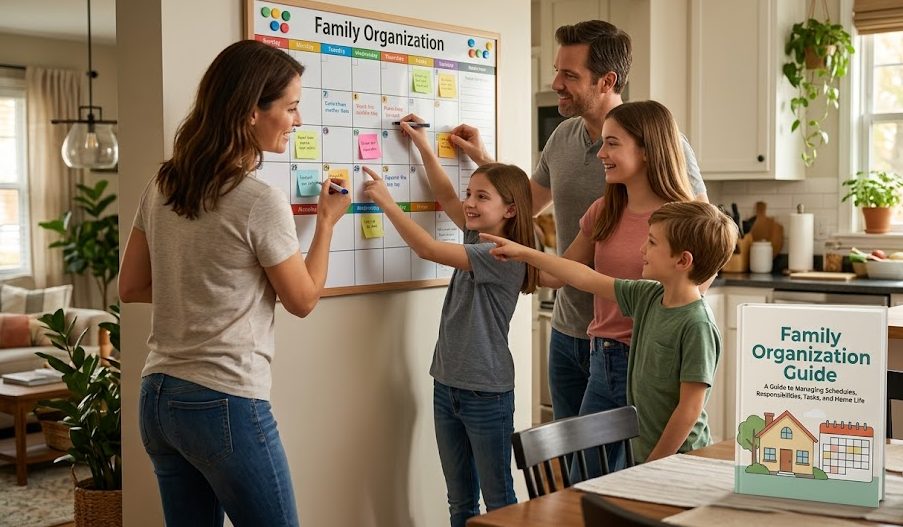
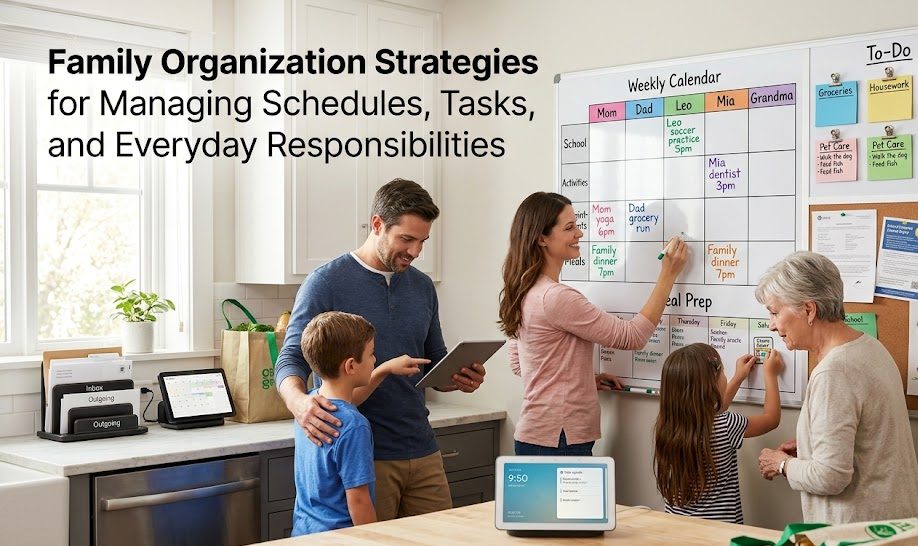
One of the most useful starting points is a shared calendar where important commitments can be seen in one place. This can be a physical calendar displayed in a common area or a digital calendar accessible to relevant family members.
Include appointments, school events, work commitments, planned trips, activities, important deadlines, and other events that affect the household. The purpose is not to record every small activity but to make major scheduling information easier to see.
When several people have different schedules, a shared calendar can reduce situations where two commitments accidentally overlap or someone forgets an important event.
What belongs on the shared calendar?
Separate Fixed Commitments From Flexible Tasks
Not every responsibility needs to be scheduled at an exact time. Some activities have fixed deadlines, while others can be completed whenever there is a suitable opportunity.
For example, a doctor’s appointment has a specific time, while cleaning a storage shelf may be completed at any convenient point during the week. Treating both tasks as equally rigid can make a family schedule unnecessarily complicated.
FIXED
Appointments
School timings
Work meetings
Important deadlines
FLEXIBLE
General cleaning
Decluttering
Some shopping tasks
Optional household projects
Hold a Short Weekly Family Planning Session
A brief weekly planning conversation can help the entire household understand what is coming next. It does not need to be a formal meeting. Ten or fifteen minutes may be enough for many families.
Review the upcoming week’s major commitments, meals, transportation needs, shopping requirements, household tasks, and anything unusual that could affect the normal routine.
The main advantage is preparation. Instead of discovering scheduling problems one at a time, the family can identify them before the week becomes busy.
A 15-minute weekly check-in
Create a Clear Task Ownership System
Household responsibilities can become a source of frustration when everyone assumes someone else will handle them. Instead of keeping responsibilities vague, identify who is normally responsible for recurring tasks.
This does not mean one person must permanently own a particular job. Responsibilities can rotate depending on schedules, abilities, and household circumstances.
Clear ownership simply removes uncertainty. Everyone knows which tasks they are expected to notice and handle.
Example responsibility categories
Use Daily Checkpoints Instead of Constant Checking
Families do not need to discuss household responsibilities throughout the entire day. A few predictable checkpoints can provide enough structure.
For example, the household can briefly check the day’s schedule in the morning, review any changes later in the day, and prepare for tomorrow in the evening.
These checkpoints reduce the need for repeated reminders and allow family members to handle their own responsibilities more independently.
What is happening today?
Has anything changed?
What needs preparation?
Plan Meals Around the Family Schedule
Meal planning becomes easier when it reflects the actual rhythm of the week. A complicated meal may work well on a relaxed weekend but become impractical on an evening when everyone has different commitments.
Identify the busiest days and choose simpler meal options for those periods. More involved cooking can be reserved for days when there is more time available.
Keeping a few dependable meal options available can also reduce last-minute decisions.
Match meals to the day
Simple and quick options.
Regular home cooking.
Try something more involved.
Keep a Shared Shopping List
A shared shopping list can prevent multiple people from buying the same item or discovering too late that something important has run out. It can be kept on paper in a common location or maintained digitally.
Encourage household members to add items when they notice supplies becoming low. This turns shopping into a shared responsibility rather than something one person has to remember entirely.
Before shopping, quickly check storage areas so that the list reflects what is genuinely needed.
Organize your list by area
Create a Family Command Center
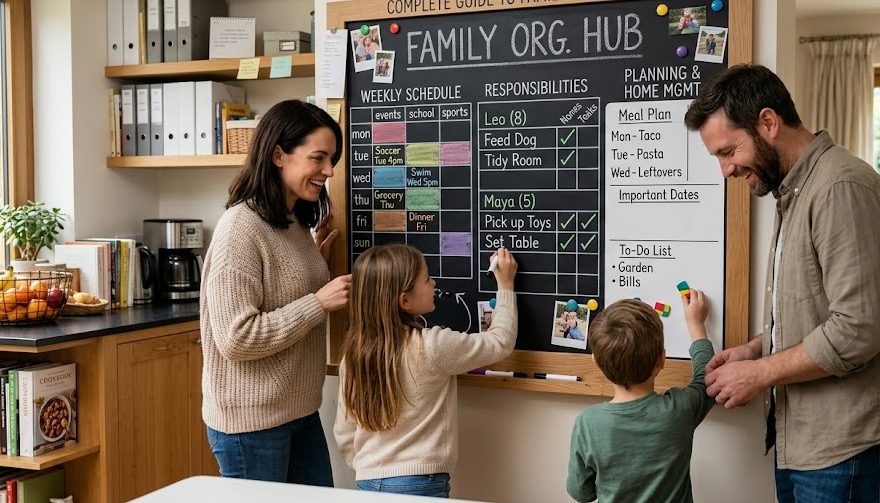
A family command center is simply a designated place where useful household information can be found. It does not have to be elaborate. A wall calendar, small notice board, document holder, or combination of physical and digital tools can work.
The area might contain the current week’s schedule, shopping notes, reminders, school information, or other non-sensitive household information.
Keep private financial details, passwords, identification information, and other sensitive documents protected rather than displaying them openly.
A simple command center can include
Use Routines for Repeating Responsibilities
Repeating household tasks are easier to manage when they become part of a routine rather than something that requires a new decision every time. Laundry, trash collection, basic cleaning, grocery planning, and certain maintenance activities can all have predictable patterns.
The schedule should match the actual needs of the household. A family that generates a lot of laundry may need a different system from a smaller household.
The goal is consistency, not unnecessary rigidity.
Use a manageable rhythm.
Coordinate with collection days.
Break larger jobs into zones.
Create Morning and Evening Checklists
Checklists can be especially useful for periods when many things need to happen in a short amount of time. A short morning checklist can help family members remember essential preparations, while an evening checklist can help the household transition into the next day.
Keep these lists short. If a checklist becomes too long, people may stop using it.
☀️ Morning
✓ Check today’s schedule
✓ Prepare essential items
✓ Confirm transportation needs
✓ Identify important priorities
🌙 Evening
✓ Review tomorrow
✓ Prepare necessary items
✓ Handle essential household tasks
✓ Reset key areas
Teach Everyone to Check the System
A family organization system works better when it does not depend on one person acting as the household reminder service. Family members should know where schedules, lists, and relevant information are kept.
Children can gradually learn age-appropriate responsibilities, while adults can coordinate tasks according to availability and practical needs.
The goal is to develop shared awareness. When everyone knows how the system works, fewer reminders need to be repeated.
Move from reminders to ownership
Instead of repeatedly saying “Don’t forget this,” encourage household members to check the appropriate calendar, list, or routine themselves.
This gradually creates more independence and reduces the mental load placed on one person.
“`Protect the Family From Schedule Overload
An organized calendar can still become overwhelming if it contains too many commitments. Family organization should include decisions about what not to schedule.
Leave some open time between demanding activities whenever possible. This provides room for travel delays, unexpected tasks, rest, or simply slowing down.
A schedule that is completely full may look productive but leave the household with little flexibility.
Before adding another commitment, ask:
❓ Is it genuinely important?
❓ Does it conflict with anything already scheduled?
❓ Who will handle transportation or preparation?
❓ Will it make an already busy day unnecessarily difficult?
❓ Can something else be removed or moved?
“`Create a Simple Paperwork System
Household documents can become difficult to manage when papers are placed randomly around the home. A basic filing system can make important information easier to locate.
Use broad categories rather than creating dozens of folders. Depending on your needs, categories might include home documents, education, warranties, maintenance, insurance, or other general household records.
Sensitive documents should be stored securely and should not be left in publicly visible household areas.
The basic filing flow
Use Technology Where It Actually Helps
Digital tools can simplify family organization, but using too many separate apps can create another layer of confusion. Choose tools based on the household’s needs rather than adopting technology simply because it exists.
A shared calendar may be enough for schedules, while a shared list can handle shopping and household tasks. Some families may benefit from reminders, while others may prefer a physical planner.
The best system is the one family members consistently understand and use.
For dates and appointments.
For shopping and tasks.
For time-sensitive responsibilities.
Plan for Unexpected Changes
No family schedule survives perfectly every day. Someone may become unavailable, an appointment may change, transportation may be delayed, or an urgent household issue may appear.
Instead of building a system that assumes everything will go according to plan, leave some flexibility. Keep a few simple meals available, avoid scheduling every minute, and know which household tasks can safely be postponed.
Flexibility is not a weakness in an organization system. It is one of the things that makes the system sustainable.
Use three task levels
Time-sensitive responsibilities.
Tasks that should be handled this week.
Tasks that can comfortably wait.
Review the Family System Regularly
Organization systems should evolve with the household. A schedule that works during one school term may not work during holidays. A system that suits a small family may need changes as responsibilities grow.
Every few months, review what is working and what is creating unnecessary effort. Remove unused lists, adjust responsibilities, simplify complicated routines, and change storage or scheduling methods when necessary.
Family system review questions
✓ Are important appointments easy to see?
✓ Does everyone know their recurring responsibilities?
✓ Are there too many reminders?
✓ Which household task causes the most confusion?
✓ Is the schedule flexible enough?
✓ What can be simplified?
“`A Practical Family Organization Framework
Put important appointments, tasks, and commitments into a shared system.
Separate fixed commitments from flexible household tasks.
Make recurring responsibilities clear to the appropriate family members.
Check the week ahead and prepare for unusual commitments.
Change the system when family needs, schedules, or responsibilities change.
Organization Should Reduce the Family’s Mental Load
A well-organized family life is not about creating a rigid timetable where every activity happens at exactly the same moment. Real households are constantly changing, and unexpected events are part of everyday life.
The purpose of organization is to make those changes easier to handle. A shared calendar can make appointments visible. A weekly planning session can reveal busy periods before they arrive. Clear task ownership can prevent responsibilities from being forgotten. Simple routines can reduce repeated decisions.
It is also important to remember that organization should not become another source of stress. If a system requires too many apps, complicated spreadsheets, or constant monitoring, simplify it. The best household system is usually the one everyone understands and can maintain without excessive effort.
Start with the biggest source of confusion in your household. If scheduling is the problem, create one shared calendar. If chores are the issue, clarify task ownership. If mornings are chaotic, introduce a short evening preparation routine. Solve the biggest problem first instead of trying to reorganize everything at once.
Over time, small improvements can create a much smoother household rhythm. Family members know where to look for information, understand what they are responsible for, and have more room to focus on work, school, relationships, hobbies, and rest.
Ultimately, successful family organization is about creating clarity without unnecessary complexity. Keep schedules visible, share responsibilities, prepare for important events, leave room for flexibility, and review the system whenever life changes. When organization quietly supports everyday life instead of dominating it, the entire household can become easier and more comfortable to manage.
“`